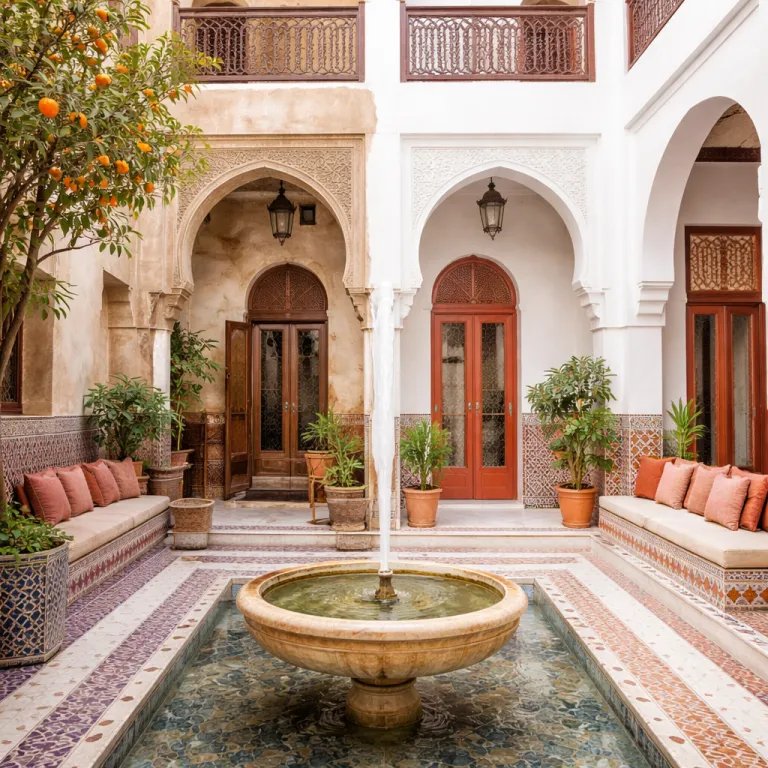
Reading an authentic riad in Marrakech from the first step inside
Walk into an authentic riad in Marrakech and pause before speaking. Let your eyes adjust to the soft light of the medina and the way sound falls away as you cross from alley to interior courtyard. In that first quiet minute, you already hold most of the clues you need to judge whether this is a truly traditional Moroccan house or a new hotel dressed in heritage.
A riad in Marrakech is defined by its inward facing architecture, with rooms wrapped around a central courtyard that protects from heat and street noise. The most characterful riads use this courtyard not as décor but as the heart of daily life, where breakfast is served, mint tea appears unprompted and the pool, if there is one, is modest in size rather than resort style. When you plan to stay in Marrakech, notice whether the courtyard trees have grown into the space over time or look like recent stage dressing.
Across the wider Marrakech medina there are now hundreds of guesthouses and courtyard houses described as riads, according to local tourism offices and restoration architects interviewed in 2023, yet only a portion retain their original structure. Many properties have been rebuilt from the ground up, while others still read as historic homes that have absorbed generations of footsteps. When you book a riad in Morocco through a luxury hotel platform, your goal is not only to find the best hotels but to understand which Marrakech riads offer genuine architectural heritage and which simply offer a beautiful stay with contemporary comforts.
Quick on‑arrival checklist (first 60 seconds)
• Step into the courtyard: listen for street noise and note how cool it feels.
• Scan the tiles and plaster: are there tiny imperfections and repairs, or is everything perfectly uniform?
• Look up: do ceilings and balconies show depth and handwork, or flat, hotel‑style finishes?
• Glance at the pool: small and integrated into the patio, or a large, resort‑like rectangle?
These fast impressions prime your eye before you start asking questions or reading marketing copy.
Five visual cues that separate heritage riads from new builds
Start with the zellige tilework under your feet and around the courtyard walls. In a truly traditional Moroccan house, the glaze on the tiles is rarely uniform, and older zellige in a Marrakech riad often shows tiny chips, softened edges and subtle colour variation that no factory finish can replicate. New construction riads may use impeccable tiles, but the surfaces can feel too perfect, with repeating patterns that look printed rather than laid piece by piece.
Look up next at the carved cedar ceilings and painted beams above the rooms. At properties such as Royal Mansour in Marrakech, which publicly documents its use of hand carved cedar and plasterwork by maâlem artisans from Fes and other craft centres, every ceiling panel is carved and painted by hand, and you can feel that same depth of craft in the best riads across Morocco. In more recent builds, ceilings may be flat plaster with decorative stencils, attractive enough for a short stay yet lacking the three dimensional relief that casts shadows at different times of day.
Then read the proportions of the courtyard and the surrounding rooms, because original riads in Marrakech were built for families, not for hotel layouts. A heritage riad in the medina often has irregular corners, slightly uneven floors and a douirya, the former servants’ quarter, tucked above the main level. When a riad has perfectly identical rooms, a large rectangular pool and a rooftop terrace that feels like a hotel deck, you are likely in a new construction property that borrows traditional Moroccan motifs rather than a fully preserved dar.
As you move through the house, notice the thickness of the walls and the way doors open from the bhou, the open sitting area off the courtyard. In older riads, doorways can be surprisingly low, with heavy wooden doors that show layers of paint and repair, while new riads in Marrakech often opt for higher, glass fronted doors to maximise light. If you are planning a longer stay in the city, these structural details will matter more to your comfort than any single decorative object.
Finally, pay attention to circulation, the way you climb from courtyard to rooftop terrace and back again. A traditional Marrakech riad often uses a narrow msrya, or passage, and staircases that turn sharply, while some of the best hotels in the medina use wider, straighter stairs to meet modern safety codes. Neither is inherently better for travel, but understanding these cues helps you decide whether you want the full historic experience of staying in a riad or the smoother flow of a contemporary hotel inspired by riads.
For a deeper architectural checklist before you book riad stays anywhere in Morocco, use a specialist guide such as a curated route through Marrakech, Fes, the Atlas and the desert, which places Marrakech riads in the wider context of the country’s hospitality landscape. That broader view will help you compare a riad in Marrakech medina with a kasbah in the mountains or a desert camp, and decide where to allocate your time. It also sharpens your eye for details, so that the next time you step into a dar, you immediately start reading the building rather than the marketing copy.
How to ask about provenance without sounding like an inspector
Once you have read the physical space, the next step is to talk to the people who run it. In an authentic riad in Marrakech, the owner or manager usually lives on site or nearby, and they tend to be proud of the house’s story, whether it is a centuries old dar or a newly built riad designed in a traditional Moroccan style. Your questions should invite that story rather than interrogate it.
Begin with open prompts about the building’s history, such as asking when the family acquired the riad or how long the restoration took. Many riads in the old city have layered histories that combine original structures with careful updates, and hosts are often delighted to explain which rooms are oldest and which parts of the courtyard were rebuilt. You can then follow up with more specific questions about the artisans, asking whether a maâlem worked on the plaster carving or whether the zellige came from Fes or another region of Morocco.
When you are evaluating options on a luxury booking website, use the same approach with written information and guest reviews. Look for mentions of traditional Moroccan craftsmanship, such as hand carved cedar, tadelakt walls and original doors, rather than generic praise for a beautiful pool or large rooms. If you see repeated references to a rooftop terrace with panoramic views, a generous breakfast in the courtyard and attentive staff who share stories about the medina, you are likely looking at one of the best riads for travellers who value both heritage and hospitality.
It also helps to cross check the property’s own description with independent guides, especially when certain riads appear frequently in travel conversations. Some well known Marrakech addresses are housed in older buildings, while others are newer constructions that excel as stylish hotels with pools and rooftop terraces. A curated resource such as a guide to the coolest hotels in Marrakech for an unforgettable luxury stay can clarify which category each property belongs to, and whether it suits your idea of an authentic stay.
Remember that the most reliable information often comes from people who work quietly behind the scenes. Housekeepers, night managers and long term staff usually know exactly which parts of the riad are original and which were added last season, and a respectful question about their favourite corner of the house can open up more honest answers than a direct query about construction dates. This is where the maâlem lineage matters; if the team names specific artisans or families who worked on the riad, you are hearing the kind of detail that rarely appears in generic hotel marketing.
When in doubt, let the building’s small imperfections reassure you. A slightly uneven staircase, a courtyard tree that leans into the pool, or a rooftop terrace with irregular tiles often signal a house that has grown over time, not a showpiece built in one construction phase. For more structured criteria on how to choose between a hotel and a riad in Marrakech, consult an expert overview such as an elegant guide to choosing a riad in Morocco for your next stay, then apply those principles to each property you consider.
Why some ‘fake’ riads are still excellent stays
Not every traveller needs to sleep under centuries old cedar to feel the pull of Marrakech. Many new construction hotels in the medina borrow the riad layout, with a central courtyard, a small pool and a rooftop terrace, and they can still deliver a memorable stay in Marrakech for guests who prioritise comfort and service. The key is to be honest with yourself about what you want from your time in Morocco.
Some of the best hotels in the city are technically not historic riads, yet they offer generous rooms, reliable heating and cooling, and thoughtful amenities that older buildings sometimes struggle to integrate. A property like Riad Malika, for example, blends an exotic garden and pool with traditional Moroccan architecture, while newer addresses such as Riad Aslal & Spa or Riad Soundouss focus on peace, hospitality and modern comfort within the Marrakech medina. These places may not have fully intact douiryas or original msrya passages, but they can still feel like the best riads for solo travellers who value quiet nights and strong Wi Fi.
There is also a middle category, where a dar has been heavily reworked yet retains enough original structure to carry a sense of place. In such houses, you might find a historic bhou opening onto a courtyard that now holds a larger pool, or a rooftop terrace that has been expanded to host breakfast with views over the heart of the medina. Staying in a riad like this can be ideal if you want both the romance of traditional Moroccan design and the predictability of a contemporary hotel stay.
Guest reviews are particularly useful when you are weighing these options on a booking platform. Look for comments that mention the balance between heritage and comfort, such as praise for quiet rooms despite the central location, or appreciation for staff who explain local things Marrakech visitors might miss, like the rhythm of the call to prayer or the best minute walk routes to Jemaa El Fna. When multiple reviews highlight the same strengths or weaknesses, you gain a clearer picture than any single marketing description of a riad in Marrakech.
Price can also signal where a property sits on the spectrum between historic dar and design forward hotel. Authentic, carefully restored riads in the Marrakech medina with limited rooms and deep craftsmanship often command higher rates, while new builds with more rooms can spread costs across more guests and offer competitive pricing. Neither option is inherently better; the best choice is the one that aligns with your priorities, whether that is sleeping in a centuries old Marrakech riad or enjoying a beautiful, well run hotel that borrows the riad form.
As you compare options, remember that “A riad is a traditional Moroccan house with an interior courtyard.” and that “Prices vary; budget riads start around $50 per night, luxury ones can exceed $200.” and that “Are riads suitable for families? Yes, many riads offer family-friendly accommodations.” and that “Do riads provide modern amenities? Many riads combine traditional architecture with modern comforts like Wi-Fi and air conditioning.” and that “Is it safe to stay in a riad? Yes, riads are generally safe; always check reviews and ratings before booking.” These verified statements, which reflect typical price ranges and facilities reported by major booking platforms and tourism boards as of 2023, frame the range of experiences available, from simple family run riads to high end hotels with pools and spas, and they remind you to read both the building and the rate card with equal care.
Glossary of riad architecture for Marrakech medina explorers
Understanding a few key terms will sharpen your eye every time you step into a riad in Marrakech. A derb is the narrow lane that leads from the main medina artery to your door, and its length and turns often determine how quiet your stay will be at night. When a property description mentions that it is only a minute walk from a major square yet still peaceful, it usually sits just far enough down the derb to escape the busiest things Marrakech throws at first time visitors.
The word dar refers to a traditional Moroccan house, and many riads in Marrakech still carry this in their names. A douirya is the upper level apartment that once housed extended family or staff, and in some of the best riads this space has been converted into guest rooms that feel more private than those on the main courtyard. The bhou is the open sitting area off the courtyard, often used for breakfast or late night tea, while the msrya is the passage or gallery that connects different parts of the house.
Knowing these terms helps you decode room descriptions on luxury booking sites, especially when you compare properties that blend historic architecture with modern design. If a riad in Marrakech highlights a douirya suite or a bhou level room, you can expect a more traditional layout than in a hotel that simply offers standard rooms around a pool. When you are staying in a riad for several nights, these nuances affect how you move through the space, where you hear the medina and how much privacy you enjoy.
Use this glossary alongside practical booking advice that applies across Morocco. Book in advance, especially during peak seasons, confirm amenities such as air conditioning, heating and pool access before arrival, and respect local customs and dress codes when moving through the medina. With that foundation, you can approach every riad in Marrakech not just as a place to sleep but as an architectural text, reading the courtyard, the rooftop terrace and the smallest msrya for clues about the life the house has lived before you arrived.
FAQ
How do I know if a riad in Marrakech is genuinely historic ?
Look for irregular layouts, thick walls, slightly uneven floors and signs of age in the zellige and woodwork rather than perfectly uniform finishes. Ask about the building’s history, the artisans involved and whether any douirya or bhou spaces remain intact. Cross check these details with independent reviews that mention heritage features, not just décor.
Is it better to stay in a riad or a hotel in Marrakech medina ?
A riad offers immersion in traditional Moroccan architecture, with a courtyard, often a small pool and close contact with hosts, while a hotel usually provides more facilities and standardised rooms. Solo travellers who value atmosphere and personal service often prefer staying in a riad, whereas those wanting lifts, large pools and extensive services may choose a hotel. The best choice depends on your comfort needs, mobility and how much time you plan to spend on site.
Are riads in Marrakech suitable for solo travellers ?
Many riads in Marrakech are excellent for solo travellers, especially smaller houses where staff quickly learn your routines and offer tailored advice on things Marrakech visitors might overlook. Look for properties with strong reviews mentioning safety, attentive hosts and clear walking routes to main landmarks. A central yet quiet derb location, ideally within a short minute walk of a taxi point, makes solo movement easier.
What should I check before I book a riad in Morocco ?
Confirm whether your room has heating and air conditioning, ask about pool access and rooftop terrace use, and check if breakfast is included in the rate. Read recent reviews to understand noise levels, staff responsiveness and the reality of the location within the medina. Finally, verify check in and check out times so your travel plans align with the riad’s schedule.
How far in advance should I reserve the best riads in Marrakech ?
For the most sought after Marrakech riads, especially those with only a few rooms, booking several months ahead is wise during peak seasons. Outside those periods, you may find availability closer to your travel dates, but specific rooms or suites can still sell out quickly. If your heart is set on a particular riad in Marrakech, reserve as soon as your travel time is fixed.